Your partner holds the Chase Sapphire Reserve. Travel and dining are already earning at an accelerated rate. What the Reserve doesn’t do is earn meaningfully on the spending that fills most household budgets: the weekly grocery run, filling the tank, a Sunday afternoon at Home Depot.
At $20,000 in annual non-travel spend, leaving those categories at the Reserve’s 1x fallback rate costs real money. On $20,000 running through the card at 1x, you generate 20,000 Ultimate Rewards points. A companion card earning 5x on $6,000 of that same spend adds 24,000 incremental points annually — enough, over two years, for a round-trip domestic transfer to United or a free night at a Hyatt category 4 property.
I will tell you on how to identify which companion card fits which household, runs the math on each option, and states a direct verdict.
Quick Answer
For most households adding a companion card to the Chase Sapphire Reserve, the Chase Freedom Flex is the right first move — it earns 5% in rotating quarterly categories that regularly cover gas, groceries, and home improvement, pools those points directly with the Reserve, and costs nothing in annual fees. Add the Chase Freedom Unlimited ($0 annual fee, 1.5% everywhere) to cover the spend the Flex misses. For households paying significant rent or a mortgage, the Bilt Palladium ($495/year) deserves a separate look. If neither partner actively uses Chase transfer partners, a flat 2% card like the Wells Fargo Active Cash or Citi Double Cash puts more actual dollars back in your pocket than Freedom points you’re unlikely to optimize.
What Does the Chase Sapphire Reserve Actually Cover — and What Does It Miss?

The Reserve’s earning structure centers on travel and dining. It earns 10x points on hotels and car rentals booked through Chase Travel, 3x on all dining, and 1x on everything else. That 1x fallback is the gap every companion card targets.
For a household running $20,000 per year on groceries, gas, and home improvement, the cost of doing nothing is roughly 24,000 points annually — or about $240–$480 in travel value depending on how you redeem. Over three years, that gap becomes a business-class transfer to a short-haul Singapore partner route, or two free nights at a mid-tier Hyatt. Small per month. Significant over time.
Which Type of Chase Sapphire Reserve Companion Card Fits Your Situation?
Which card should you pair with the Chase Sapphire Reserve?
Answer 3 quick questions to find the right companion card for your spending habits.
Transfer partners include airlines like United, British Airways, and Singapore Airlines, and hotels like Hyatt and IHG. If you mostly book through the Chase Travel portal or use points for cash back, that counts as "no."
The Chase Freedom Flex requires you to activate new 5% bonus categories each quarter — gas one quarter, Amazon another. Takes about 30 seconds but needs a reminder. If you'd rather set it and forget it, there's a simpler option.
The Bilt Palladium is the only premium card that lets you earn rewards on housing payments with no transaction fee. If that applies to you, it changes the math significantly — even with a $495 annual fee.
Earns 5% in rotating quarterly categories (gas, groceries, Amazon, home improvement, and more rotate through). When pooled into your Sapphire Reserve, those 5x points transfer to Hyatt, United, and 11 other partners at full value. On $1,500/quarter in bonus categories, that's 30,000 incremental points per year over using the Reserve alone.
Use this for every purchase the Flex doesn't bonus. The 1.5% flat rate beats the Reserve's 1x fallback on every dollar. Combined with the Flex, your entire non-travel spend now earns at an elevated rate — all pooling into the Reserve at no additional annual fee.
💡 The math: At $20,000/year in non-travel spend, this setup generates roughly 44,000 Ultimate Rewards points vs. 20,000 on the Reserve alone. Combined annual fees: $0.
Earns a guaranteed 1.5% on every purchase — no tracking, no quarterly activations, no category math. Those points pool into your Sapphire Reserve and transfer to airline and hotel partners at full value. On $20,000 in annual non-travel spend, that's 30,000 extra Ultimate Rewards points per year compared to using the Reserve's 1x fallback rate.
💡 Note: If you later decide to track categories, add the Freedom Flex. The two cards together — still $0 in annual fees — are a common upgrade path.
The only premium card that earns rewards on rent and mortgage payments with zero transaction fees. With $1,500+/month in housing, that's up to 18,000 Bilt Points per year from your largest monthly expense alone. The $400 Bilt Travel hotel credit and $200 annual Bilt Cash offset the fee — but only if you use both. Run the math before applying.
⚠️ Important: Bilt earns two separate currencies (Bilt Points + Bilt Cash). The rewards structure is more complex than Chase's. Review the full terms at biltrewards.com before applying.
Since you're not using Chase transfer partners, there's no reason to stay in the Chase ecosystem. A flat 2% card returns $200 per $10,000 in spend — beating the Freedom Unlimited's 1.5% by $50 on every $10k. No quarterly activations, no ecosystems to manage, no annual fees. Pure cash.
💡 Note: Both cards charge a 3% foreign transaction fee. If you travel internationally and charge purchases abroad, verify current card terms before applying.
The right answer depends less on the cards and more on the household. Four profiles cover most people who ask this question.
The points optimizer ($20k–$40k annual spend, uses transfer partners). This household wants to maximize Ultimate Rewards accumulation for transfer awards — Hyatt, United, British Airways, Singapore. The Freedom Flex as a category earner plus the Freedom Unlimited as a catch-all is the right structure. Zero annual fees, full ecosystem integration.
The frequent traveler who already has too many cards. The Freedom Unlimited alone handles this. One card, 1.5x on everything the Reserve doesn’t bonus, no activation calendar to manage. Points pool into the Reserve automatically.
The renter or homeowner making $1,500+/month in housing payments. The Bilt Palladium becomes relevant here, and only here. No other card earns rewards on rent or mortgage without transaction fees. The $495 annual fee math works — but only if you actually use the credits.
The cash-back-focused household that doesn’t travel for points. This profile should leave the Chase ecosystem entirely. A flat 2% card delivers more usable value than Freedom points that require a Reserve to redeem at full value. If the Reserve gets cancelled someday, those Freedom points drop to 1 cent each.
Does the Chase Freedom Flex Cover Gas, Groceries, and Home Improvement?
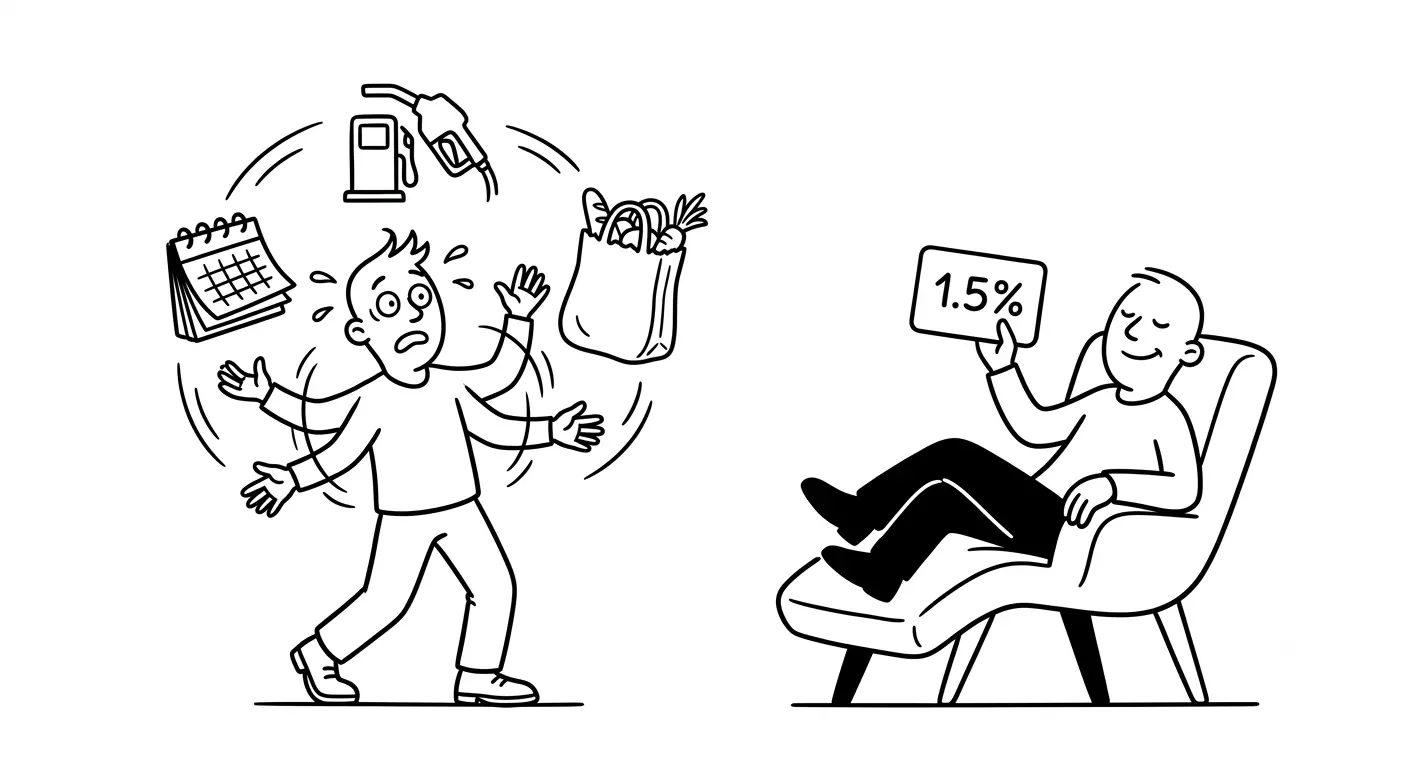
Yes — and more consistently than most people expect.
The Freedom Flex earns 5% cash back on up to $1,500 in combined purchases in activated quarterly bonus categories, with new categories each quarter. Gas stations and grocery stores appear in the rotation most years. Home improvement retailers have appeared in recent rotations. For Q3 2026, Chase confirmed gas stations, EV charging, select live entertainment, and transit as the 5% categories from July 1 through September 30, 2026. Q2 2026 ran Amazon and Whole Foods Market. Chase announces categories shortly before each quarter begins — check the current rotation at chase.com/FreedomFlex.
Outside the rotating categories, the card earns 5% on Chase Travel bookings, 3% on dining and drugstores, and 1% on everything else.
The structural limitation is real: you cannot control which categories Chase selects, and the $1,500 quarterly cap is a ceiling, not a floor. In a quarter where the bonus categories don’t match your spending, the Freedom Flex is a 1% card on most purchases. That gap is exactly what the Freedom Unlimited fills.
| Detail | Information |
|---|---|
| Annual fee | $0 |
| Rotating category rate | 5% on up to $1,500 in combined quarterly spend (activation required by deadline) |
| Travel (via Chase Travel) | 5% |
| Dining + drugstores | 3% |
| All other purchases | 1% |
| Welcome bonus | Verify current offer at chase.com |
| APR | 18.24%–27.74% variable after 15-month 0% intro period — verify at chase.com |
| Best for | Households willing to track quarterly categories within the Ultimate Rewards ecosystem |
Rates and terms change. Verify current details at chase.com before applying.
Is the Chase Freedom Unlimited a Better Fit If You Don’t Want to Track Quarterly Categories?
For households that want consistent earnings without a quarterly activation calendar, the Freedom Unlimited is the cleaner option.
The card earns unlimited 1.5% cash back on all purchases, plus 3% on dining and drugstores and 5% on Chase Travel — no annual fee, no rotating categories, no activation required. On $20,000 in annual non-travel spend, that’s 30,000 Ultimate Rewards points at the flat rate, compared to 20,000 on the same spend using only the Reserve.
The tradeoff is the ceiling. The Freedom Flex earns 5x during relevant quarters; the Freedom Unlimited earns 1.5x everywhere, always. For a household spending $1,500 per quarter at the pump during a summer gas-bonus quarter, the Freedom Flex nets 7,500 points — the Freedom Unlimited nets 2,250. Outside those quarters, the Unlimited wins on every unbonus dollar.
Many households run both — Flex for bonus category spend, Unlimited for everything else. Total annual fees for the combination: still $0.
| Detail | Information |
|---|---|
| Annual fee | $0 |
| Base rewards rate | Unlimited 1.5% on all purchases |
| Travel (via Chase Travel) | 5% |
| Dining + drugstores | 3% |
| Welcome bonus | Verify current offer at chase.com |
| APR | 18.24%–27.74% variable after 15-month 0% intro period — verify at chase.com |
| Best for | Households wanting a no-fuss catch-all within the Chase ecosystem |
Rates and terms change. Verify current details at chase.com before applying.
How Do Chase Freedom Points Actually Pool With the Sapphire Reserve?
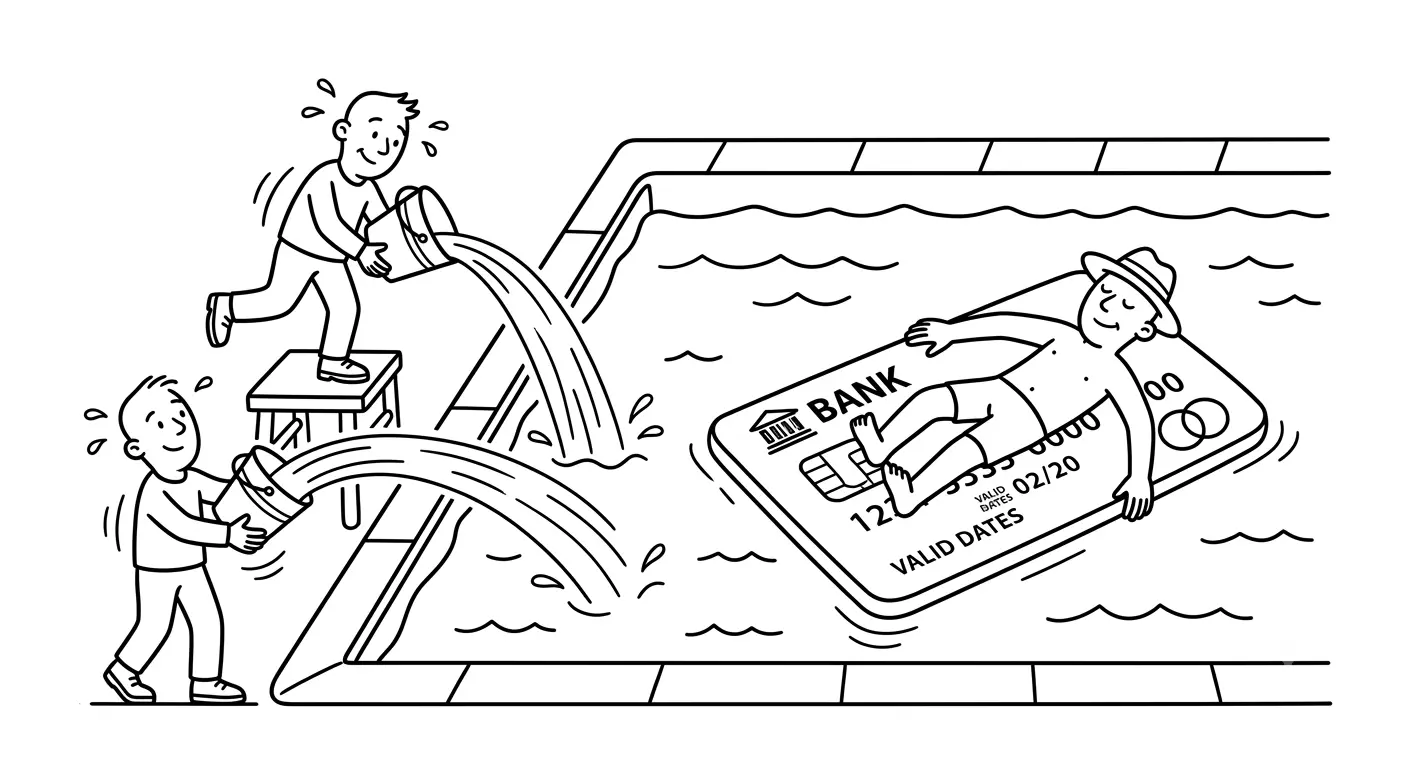
Chase allows cardmembers to transfer points between their own eligible accounts. Points earned on the Freedom Flex or Freedom Unlimited — which would otherwise redeem for 1 cent each as cash back — move into the Sapphire Reserve account, where they become eligible for transfer to Chase’s airline and hotel partners at a 1:1 ratio.
The Ultimate Rewards Transfer Mechanic: This pooling only works when at least one account in the household holds a card that earns transferable Ultimate Rewards (Reserve, Sapphire Preferred, or Ink Business Preferred). Freedom cards alone cannot transfer to airline or hotel partners. When those Freedom points sit in the Reserve account, they can move to United MileagePlus, World of Hyatt, British Airways Executive Club, Air France/KLM Flying Blue, Singapore Airlines KrisFlyer, Aer Lingus, Air Canada Aeroplan, JetBlue TrueBlue, Southwest Rapid Rewards, Virgin Atlantic Flying Club, Iberia Plus, IHG One Rewards, Marriott Bonvoy, or Wyndham Rewards at a 1:1 ratio. Confirm current transfer ratios at chase.com/ultimate-rewards before planning a redemption — Chase recently adjusted its World of Hyatt transfer ratio for newer Sapphire Preferred cardmembers, and the Reserve’s terms are separate.
For a household not using transfer partners, this entire mechanism is irrelevant, and a flat 2% cash card produces more usable value. Worth identifying which camp you’re in before committing to the ecosystem.
Should You Consider Leaving the Chase Ecosystem for a Flat 2% Card?

This is the question the Chase-centric discussion usually skips.
Two cards earn flat 2% cash back with no annual fee, and both beat the Freedom Unlimited’s 1.5% base rate on every purchase outside Chase bonus categories.
Wells Fargo Active Cash earns unlimited 2% cash rewards on all purchases with no annual fee and no categories to track. Welcome bonus of $200 after $500 in purchases in the first 3 months — one of the lowest spending thresholds available. Note that the card charges 3% on international purchases. APR after the 12-month 0% intro period runs 18.49%–28.49% variable — verify current terms at wellsfargo.com.
Citi Double Cash also earns 2% on all purchases — 1% when you buy, 1% when you pay. No annual fee, no categories. Technically earns Citi ThankYou Points, which can be transferred to Citi travel partners if you hold a premium Citi card, but standalone the card is most useful as a pure cash-back tool. APR runs 17.49%–27.49% variable — verify current terms at citi.com.
The case against both: neither integrates with Chase Ultimate Rewards. Points earned on these cards cannot be pooled with the Sapphire Reserve for transfer partner redemptions. For a household that pays off monthly and doesn’t actively use transfer partners, the math favors the 2% flat-rate cards on most purchases — $200 per year on $10,000 in non-bonus spend, versus $150 from the Freedom Unlimited’s 1.5x rate. Over five years, that’s a $250 difference. Small but real.
| Detail | Wells Fargo Active Cash | Citi Double Cash |
|---|---|---|
| Annual fee | $0 | $0 |
| Rewards rate | Unlimited 2% on all purchases | 2% on all purchases (1% buy + 1% pay) |
| Welcome bonus | Verify at wellsfargo.com | Verify at citi.com |
| APR (after intro) | 18.49%–28.49% variable | 17.49%–27.49% variable |
| Foreign transaction fee | 3% | 3% |
| Chase ecosystem compatible | No | No |
| Best for | Households wanting maximum flat-rate cash back without category management | Households open to Citi’s travel partner network alongside cash back |
Rates and terms change. Verify current details at the issuer’s website before applying.
Should You Consider the Bilt Palladium Card Instead of Staying in the Chase Ecosystem?
For a specific household profile, yes. For most people asking this question, no.
The Bilt Palladium carries a $495 annual fee and earns 2x points on everyday purchases excluding rent and mortgage. Its defining feature is something no other premium card offers: the ability to earn points on rent and mortgage payments with zero transaction fees. At $1,800 per month in rent, that’s potentially 21,600 Bilt Points per year from housing alone at the maximum earning rate — worth $300–$450 when transferred to partners.
The annual fee math: a $400 Bilt Travel portal hotel credit (split as $200 semi-annually, applied to qualifying hotel bookings through Bilt’s portal) and $200 in annual Bilt Cash together total $600 in credits against a $495 fee. Net-positive on paper — but only if you use both credits fully and book hotels through Bilt’s portal specifically.
Two complications are worth understanding before applying. Bilt runs parallel currencies (Bilt Points and Bilt Cash), and the housing rewards mechanics are tied to non-housing spend levels. The card also launched with documented customer service friction during the 2.0 rollout. This is a card that rewards organized spenders — not a passive option.
For a household spending $20,000 annually on gas, groceries, and home improvement without a significant housing payment, the Palladium is hard to justify. Paying $495 for 2x everyday earning when the Freedom Flex delivers 5x in relevant bonus categories at $0 annual fee is a straightforward loss. The Palladium earns its place when housing payments are running through Bilt — not as a pure everyday-spending play.
The Bilt World Elite Mastercard is worth a separate look if rent is your single biggest monthly expense — we’ll cover that trade-off in a dedicated review soon.
| Detail | Information |
|---|---|
| Annual fee | $495 |
| Everyday purchases (non-housing) | 2x Bilt Points |
| Rent/mortgage | Up to 1.25x with conditions — verify at biltrewards.com |
| Annual credits | $400 Bilt Travel hotel credit + $200 Bilt Cash |
| Welcome bonus | Verify current offer at biltrewards.com |
| APR | 10% intro for 12 billing cycles, then 26.74%–34.74% variable — verify at biltrewards.com |
| Best for | Renters or homeowners paying $1,500+/month in housing who will actively use portal hotel credits |
Rates and terms change. Verify current details at biltrewards.com before applying.
Opportunity Cost Comparison: How Much Does the Reserve’s 1x Fallback Actually Cost You?
| Annual Spend | Reserve Alone (1x) | With Freedom Flex (5x on $6k, 1x on $14k) | With Freedom Unlimited (1.5x flat) | With 2% Flat Card |
|---|---|---|---|---|
| $10,000 | 10,000 pts | 24,000 pts (blended) | 15,000 pts | $200 cash |
| $20,000 | 20,000 pts | 44,000 pts (blended) | 30,000 pts | $400 cash |
| $30,000 | 30,000 pts | 64,000 pts (blended) | 45,000 pts | $600 cash |
Freedom Flex estimate assumes $1,500/quarter in bonus categories at 5x, remaining spend at 1x. Pooled Freedom points are worth 1.5–2 cents through Reserve transfer partners on good awards; 1 cent as cash back. Verify current card terms before calculating. Numbers are illustrative.
At $30,000 in annual everyday spend, a household running only the Reserve leaves roughly 34,000 points on the table annually compared to the Chase two-card setup. Over three years: 100,000+ points — well past the threshold for a confirmed Hyatt category 5 redemption or a business-class transfer on a Singapore Airlines partner route.
Which Chase Sapphire Reserve Companion Card Is Right for Your Household?
- Maximize Ultimate Rewards, organized enough to track quarterly activations: Chase Freedom Flex + Chase Freedom Unlimited together. $0 in combined annual fees. Flex handles bonus category quarters at 5x; Unlimited covers everything else at 1.5x.
- One additional card with no management overhead: Chase Freedom Unlimited. Consistent 1.5x on everything, full ecosystem integration, $0 fee.
- Significant rent or mortgage, and committed to using Bilt’s portal credits: Bilt Palladium. Run the fee math with your actual housing payment before applying.
- Pay off monthly, don’t use transfer partner awards: Wells Fargo Active Cash or Citi Double Cash. Two percent on everything, $0 annual fees, no ecosystems to manage.
- Student or early in credit history: Chase Freedom Unlimited is the better starting point — lower approval requirements than some competitors, and it grows with you if you eventually get your own Sapphire card.
What We Would Do
For the specific situation described — $20,000 in annual non-travel spend, monthly payoff, partner holding the Reserve — the Freedom Flex as a primary companion is the right first card. Not because it’s the simplest option, but because the math is compelling at that spend level.
At $20,000 per year, roughly $5,000 runs through the card each quarter. If the Freedom Flex’s bonus categories cover $1,500 of that quarterly spend at 5x — and gas, groceries, and Amazon cover that cap in most quarters — you’re generating 7,500 points per quarter versus 1,500 on the Reserve alone. Over a full year that’s 24,000 additional Ultimate Rewards points. Pooled into the Reserve and transferred to Hyatt, that approaches two free nights at a mid-tier property. The welcome bonus ($200 after $500 in spend) is also among the easiest to capture on this list.
On remaining spend that doesn’t hit a bonus category, the Freedom Unlimited at 1.5x beats the Freedom Flex’s 1% fallback on every dollar. Total cost to run both: $0 in annual fees.
The Bilt Palladium is worth a separate conversation if this household pays rent. It is not the right primary companion card for a household whose spend is primarily gas, groceries, and home improvement.
One honest note: if neither partner actively uses Chase transfer partners — if most Reserve redemptions go through the Chase Travel portal at 1.5 cents per point rather than transferred to airlines and hotels — the 2% flat-rate case gets stronger. Run the math on what you’re actually redeeming for before committing to the ecosystem.
FAQ
Can I combine my Chase Freedom points with my partner’s Chase Sapphire Reserve? Chase allows point transfers between accounts in the same household sharing the same address, but both accounts must be under separate cardmembers’ names. You’d typically pool your Freedom points into the person holding the Reserve, then use the Reserve account to transfer to partners. Verify current household transfer rules at chase.com — the mechanics have changed before and could change again.
What happens if I miss the quarterly activation deadline on the Freedom Flex? You earn 1% on those purchases for the entire quarter with no retroactive adjustment. Chase sends email and app notifications, but the most reliable approach is a calendar reminder at the start of each quarter. Activation for Q3 2026 closes September 14, 2026 — purchases in qualifying categories before that date still count once you activate. Confirm the current deadline at chase.com/FreedomFlex.
Can I downgrade the Sapphire Reserve to a no-fee card if I want to cancel? Chase allows product changes from the Reserve to a Freedom card (Flex, Unlimited, or Rise), which preserves your Ultimate Rewards points balance. If you close the Reserve outright without a backup card that earns transferable Ultimate Rewards, any pooled Freedom points fall back to 1 cent each — they can no longer transfer to airline and hotel partners. Keep at least one Chase card with transfer capabilities if the points matter to you.
Does the Wells Fargo Active Cash earn more than the Freedom Unlimited on grocery and gas spend? On purchases outside Chase bonus categories, yes — 2% beats 1.5% by half a cent per dollar. On $10,000 in grocery and gas spend annually, that’s $50 more in cash from the Active Cash. The tradeoff is that those earnings stay as Wells Fargo cash rewards, not Ultimate Rewards points that can be transferred to airlines and hotels.
What happens to my Freedom card points if I cancel the Chase Sapphire Reserve? Without a card earning transferable Ultimate Rewards (Reserve, Sapphire Preferred, or Ink Business Preferred), any points on your Freedom cards revert to 1-cent-per-point redemptions — cash back only, no transfer partners. The points don’t disappear, but they lose access to the transfer partner ecosystem. If you plan to cancel the Reserve, either transfer outstanding points first or product-change to a lower-cost card with transfer capabilities rather than canceling outright. Review current rules at chase.com/ultimate-rewards.
What is the current Chase Freedom Flex quarterly activation deadline? For Q3 2026 (July 1 – September 30, 2026), activate by September 14, 2026. Categories include gas stations, EV charging, select live entertainment, transit, and United Way donations. Always confirm the active categories and activation deadline directly at chase.com/FreedomFlex — Chase does not announce future quarters in advance.
The Freedom Flex is the right companion card for most households running this spend profile — zero annual fee, high ceiling in relevant quarters, and full ecosystem compatibility with the Reserve. The one scenario where that answer changes is a household that doesn’t use transfer partners, in which case a flat 2% card clears the bar on pure math every time.
Disclaimer: The information on RawCents is for educational purposes only and does not constitute financial or investment advice. Always consult a qualified financial professional before making decisions about your money. Card terms and rates are subject to change; verify current details with the issuer before applying.