Best Credit Card for a Young Married Couple With No Credit History
Quick Answer
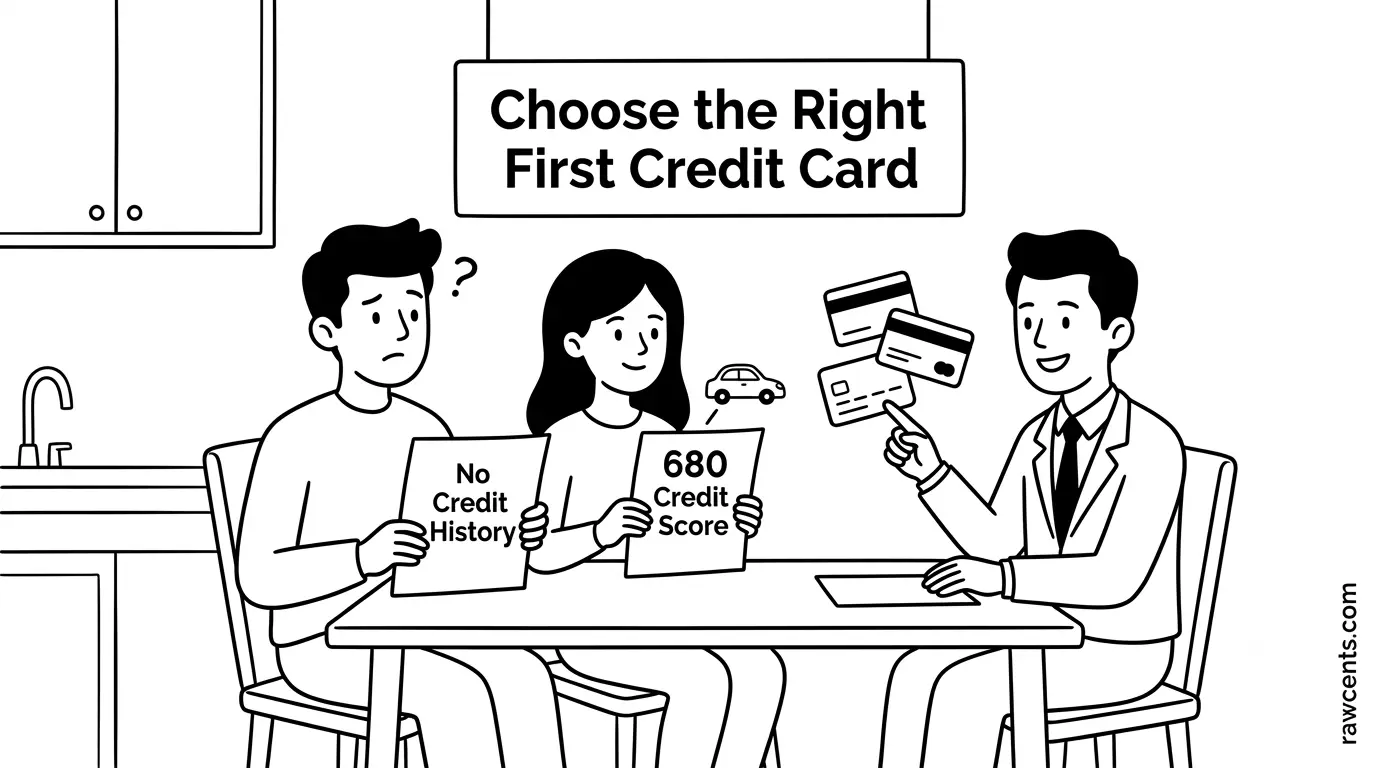
For a young married couple where one spouse has no credit history and the other has a thin file — say, a single auto loan and a mid-600s score — there’s no single “best” card, because the two of you aren’t the same applicant. The no-history spouse should start with a secured card from an issuer with a predictable graduation path (Discover it® Secured is the strongest default). The spouse with some history can usually go straight to an unsecured flat-rate cashback card like the Citi Double Cash, though Chase typically wants a year of revolving credit first. Apply individually, not jointly — most major issuers stopped offering joint credit cards years ago. Keep utilization low, pay in full, and let both accounts age.
Two people can apply for a credit card on the same afternoon and get evaluated by completely different logic. One has an empty file, nothing for an algorithm to read. The other has a 680 built from a single car loan. It’s thin, but it’s real data. Understanding why issuers treat those two files differently matters more than any specific card recommendation, because it’s what determines whether an application gets approved, denied, or quietly capped for years.
That’s the actual situation for a lot of young married couples: one spouse with no credit history at all, one spouse with a 680 from a partially paid auto loan. The real question isn’t “which card is best” in the abstract. It’s which underwriting model fits the file each of you actually has right now.
Can You Get Approved With No Credit History?
Yes. A blank file isn’t the same problem as a bad file. A bad file has negative marks: late payments, collections, charge-offs. A blank file simply has no data at all, and a small group of issuers — Discover chief among them — built their beginner products specifically to underwrite that situation using income, identity, and banking relationship instead of an existing score.
The three national credit bureaus (Experian, Equifax, and TransUnion) can’t generate a FICO or VantageScore for an account that doesn’t exist yet. Once a card reports its first statement, usually 30 days after opening, a score becomes calculable. Before that, an applicant is functionally invisible to the scoring models, not penalized by them.
Why Do Issuers Evaluate Thin Files So Differently?
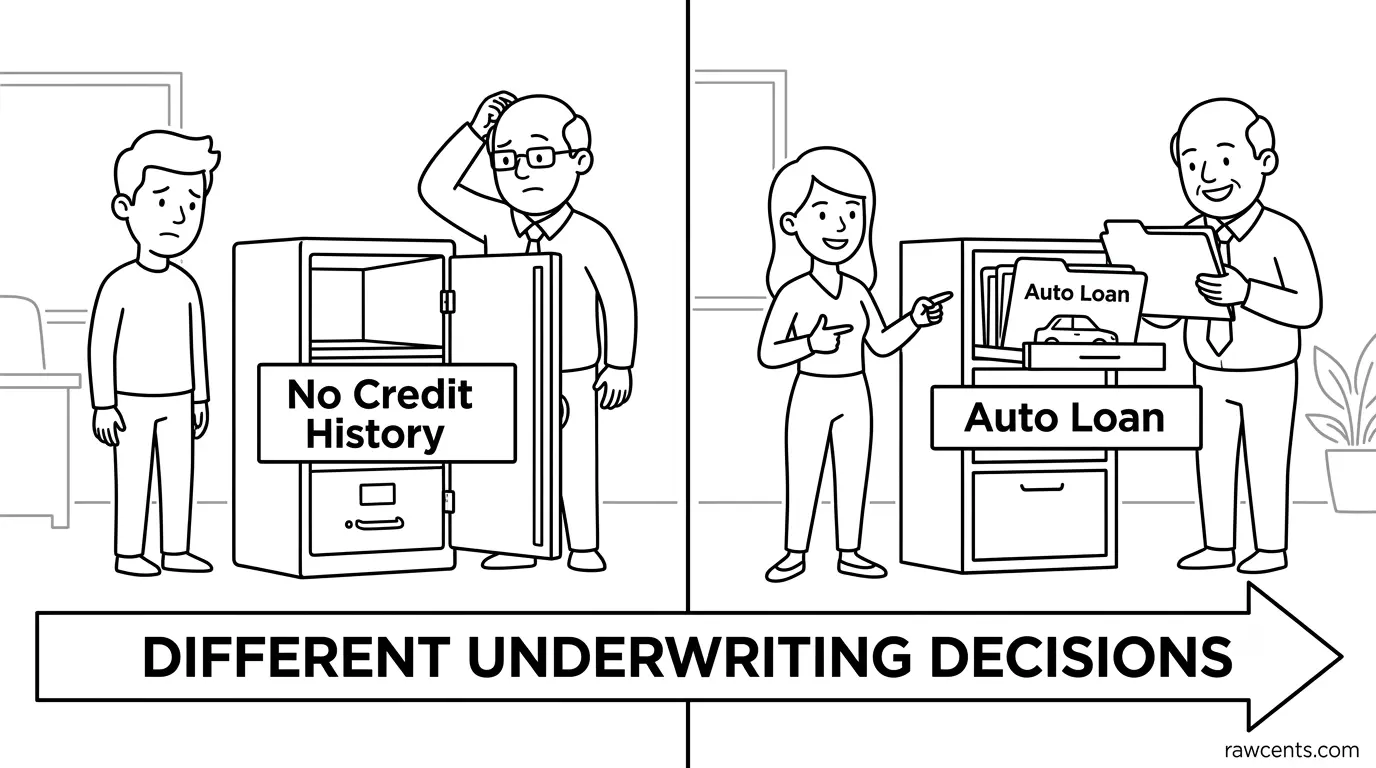
This is the part most beginner-card articles skip, and it’s the part that actually determines which card to apply for first.
Each issuer runs its own proprietary underwriting model on top of the credit bureau data. Discover leans on income, deposit amount, and ongoing payment behavior for its secured product, and reviews accounts periodically for graduation rather than on a fixed calendar. A secured cardholder who pays on time and keeps utilization low can move to unsecured well before any preset date. Capital One uses an automated system that sorts new accounts into risk tiers at approval, and for a thin or blank file, that tier is often a low one — a credit limit that can stay capped at $300–$500 for years even as the applicant’s score climbs elsewhere. Chase weighs revolving credit history specifically (installment loans like auto loans count for less in its model) and generally wants around a year of open revolving accounts, or an existing checking or savings relationship, before approving a thin file for one of its standard cards. For a deeper look at how strict Chase gets about this once you’re applying for more than one card, see our breakdown of the Chase 5/24 rule.
None of this is published anywhere in plain language by the issuers themselves. It shows up in approval and denial patterns over time, which is why matching the applicant to the issuer matters more than chasing the card with the best advertised rewards rate.
Approval Reality Matrix
| Applicant Profile | Most Likely Outcome |
|---|---|
| No file, no prior accounts | Secured card (Discover preferred over unsecured Capital One) |
| Single auto loan only, no revolving history | Beginner unsecured card (Citi Double Cash, Capital One Quicksilver) |
| 12+ months of revolving credit, on-time | Eligible for most standard unsecured cards, including Chase |
| Authorized user history only, no primary account | Treat as thin file — apply as if starting from zero |
How Do FICO and VantageScore Read a New File?
Both major scoring models pull from the same bureau data but weight it slightly differently. Knowing what each factor measures explains why the advice in this article is structured the way it is.
Revolving utilization is the balance-to-limit ratio on credit cards specifically, and it’s one of the fastest-moving factors in either model; it can swing a score within a single billing cycle. Installment utilization, by contrast, measures how much of an original loan balance (auto, student, personal) remains, and it moves slowly and matters less to the score once the loan is a few years old. That’s part of why a car loan alone doesn’t fully substitute for a credit card when building a strong revolving history.
Hard inquiries happen when a lender pulls a full credit report to decide on an application, and each one causes a small, temporary dip that fades over about a year, though it stays visible on the report for two. Soft inquiries, like pre-qualification checks, don’t touch the score at all, which is why using them first is close to a free option.
A thin file simply means too few accounts or too little history for a model to score with full confidence. It’s treated cautiously, not negatively. Average account age rewards accounts that have been open a long time, which is part of why closing a first card a year in can do more damage than keeping it open unused. Credit mix, a blend of installment and revolving accounts, helps modestly once a file has enough history to evaluate. It’s a minor factor early on, not something to chase before an applicant even has a first card. New credit tracks how many accounts and inquiries have shown up recently; opening several accounts in a short window reads as risk-seeking behavior to the model, regardless of how each individual account performs.
Which Card Should the No-History Spouse Apply For?
| Card | Annual Fee | Rewards | Refundable Deposit | Graduation Pattern |
|---|---|---|---|---|
| Discover it® Secured | $0 | 2% at gas stations and restaurants (up to $1,000 in combined spend per quarter), 1% on everything else, matched dollar-for-dollar at year one | Yes, minimum $200 | Behavior-based review, often starting around month 7 |
| Capital One Platinum Secured | $0 | None | Yes, as low as $49–$200 depending on approval | Possible, but tied to automated risk-tier placement |
Rates and terms change. Verify current details at discover.com or capitalone.com before applying.
Discover’s graduation process is periodic and behavior-based rather than a fixed guarantee tied to a specific date. The account is reviewed against actual payment history and usage, and moves to unsecured (with the deposit refunded) when that history supports it. That’s why it tends to outperform an unsecured Capital One starter card for a no-history applicant: Capital One’s system sorts the account into a risk tier at the moment of approval, and a thin file often lands in a low tier with a limit that doesn’t move much even after a year or two of clean payments.
Expert Tip: Don’t chase rewards on the first card. Approval odds and a clean graduation path matter more in year one than an extra 0.5% cashback on groceries.
There’s a rule that applies specifically to this situation and gets missed constantly: under 12 CFR § 1026.51, any applicant 21 or older can include household income on a credit application, not just their own, as long as they have a reasonable expectation of access to those funds. A spouse who’s between jobs, working part-time, or staying home doesn’t have to report $0 income on their own application. Reporting the full household income legally and materially improves approval odds for a starter card, secured or not.
Which Card Should the 680-Score Spouse Apply For?
| Card | Annual Fee | Rewards | Underwriting Note |
|---|---|---|---|
| Citi Double Cash | $0 | 2% total (1% on purchase, 1% on payment) | Rewards on-time payment behavior directly in the earning structure |
| Capital One Quicksilver | $0 | 1.5% flat cashback | Bucketing risk is lower once there’s an established score to evaluate |
| Chase Freedom Unlimited | $0 | 1.5% flat (5% travel through Chase, 3% dining/drugstores) | Chase generally wants ~12 months of revolving history, or an existing banking relationship |
Rates and terms change. Verify current details at citi.com, capitalone.com, or chase.com before applying.
A single auto loan is installment credit, not revolving credit, and Chase’s model weights those differently. A 680 built entirely on an installment loan often isn’t enough on its own for approval. Citi Double Cash or Capital One Quicksilver are the more realistic first approvals; Chase becomes a stronger fit after the first revolving account has reported for close to a year.
Secured vs. Unsecured: What Actually Changes?
| Secured | Unsecured | |
|---|---|---|
| Collateral | Refundable deposit, usually sets the limit | None |
| Approval basis | Deposit amount, income, identity | Score, income, existing file depth |
| Limit growth | Behavior-based, issuer-dependent | Set at approval, grows with reviews |
| Best fit | No file or recovering credit | Any existing score, even thin |
Authorized User vs. Primary Cardholder
| Authorized User | Primary Cardholder | |
|---|---|---|
| Builds own credit file | Partially, and increasingly discounted by scoring models | Fully, the account reports directly under them |
| Liable for the debt | No | Yes |
| Useful for | A short-term score bump while applying elsewhere | Long-term, independent credit building |
Adding a spouse as an authorized user isn’t a mistake, but it’s not a substitute for a primary account. Scoring models and manual underwriting reviews increasingly discount authorized-user tradelines because they’re easy to add without any real financial responsibility attached. In practice, it works best as a short-term bridge: something that helps a thin file look slightly less thin while the primary application for a card in that person’s own name is in progress.
Why Not a Joint Card?
Because it’s rarely on the table anymore, separate from whether it’s a good idea. Chase, Citi, Capital One, Discover, and American Express have all phased out standard joint credit card applications over the past decade, a shift that traces back to CARD Act liability rules making joint accounts more complex to underwrite and service than individual ones with an authorized user option instead. Apple Card’s “Co-Owner” structure is one of the only mainstream exceptions left.
Even where a joint account were available, it would only solve half a couple’s problem: it builds one shared history, not two independent files. With one spouse starting at zero, that’s the opposite of what’s needed here.
Why Does Prequalification Matter Before Applying?
Because a hard inquiry from a denial affects the score, and a soft-pull check doesn’t. Prequalification tools run through the issuer directly (discover.com/pre-approve, capitalone.com/pre-qualify) and use a soft inquiry to estimate approval odds without touching either bureau file. Skipping this step and applying blind on two thin files in the same week risks two denials and two hard inquiries with nothing gained, which reads worse to future lenders than simply not having a card open yet.
A Simple Decision Path
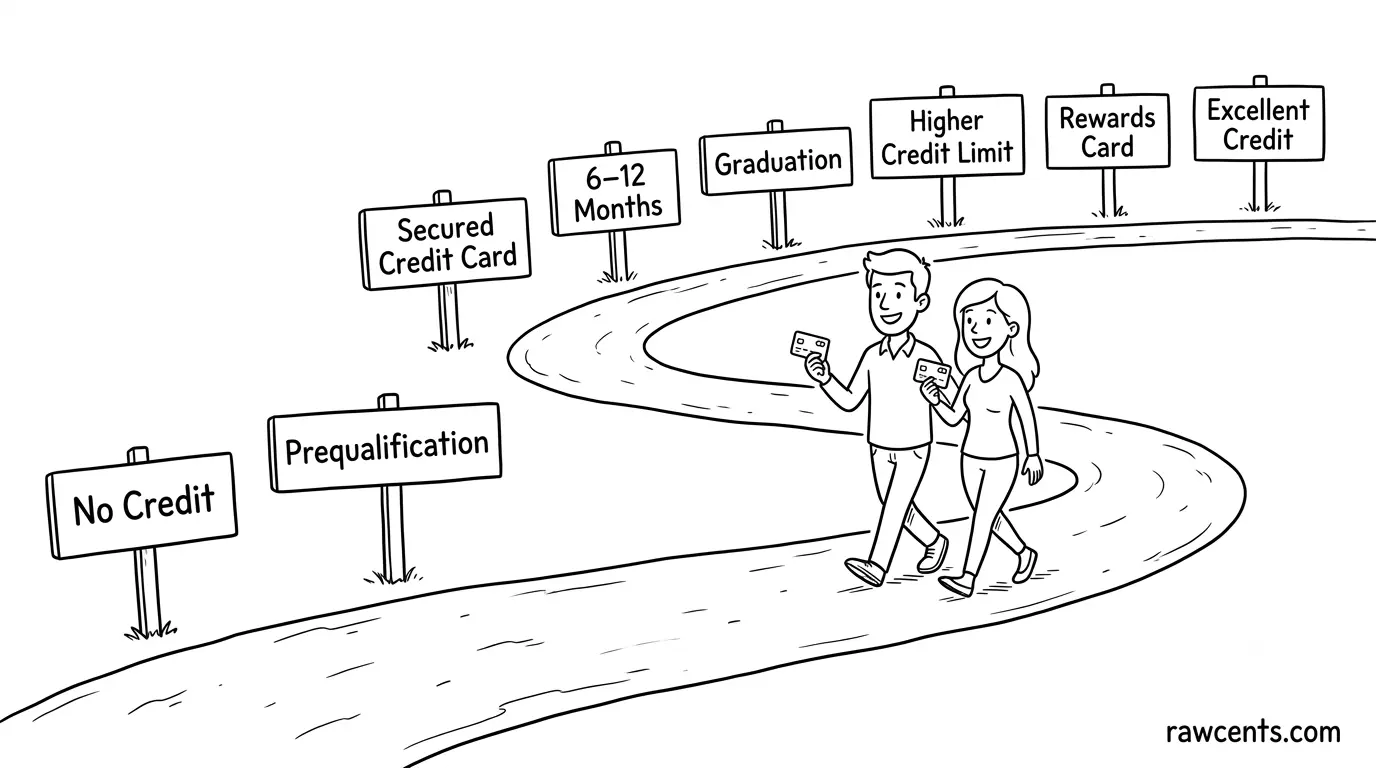
No credit history → check income eligibility under household-income rules → prequalify for secured → approved → open Discover it® Secured → 6–12 months of on-time payments → graduation review → apply for second card.
Some revolving history (auto loan, 680 score) → prequalify for unsecured beginner card → approved → open Citi Double Cash or Quicksilver → 12 months of history → eligible for Chase or a rewards upgrade. If a rewards card ends up being the next move for either spouse, our comparisons of dining rewards cards and cards worth pairing together are a reasonable next stop once both files have some age on them.
Three Mistakes That Cost Beginners Approvals
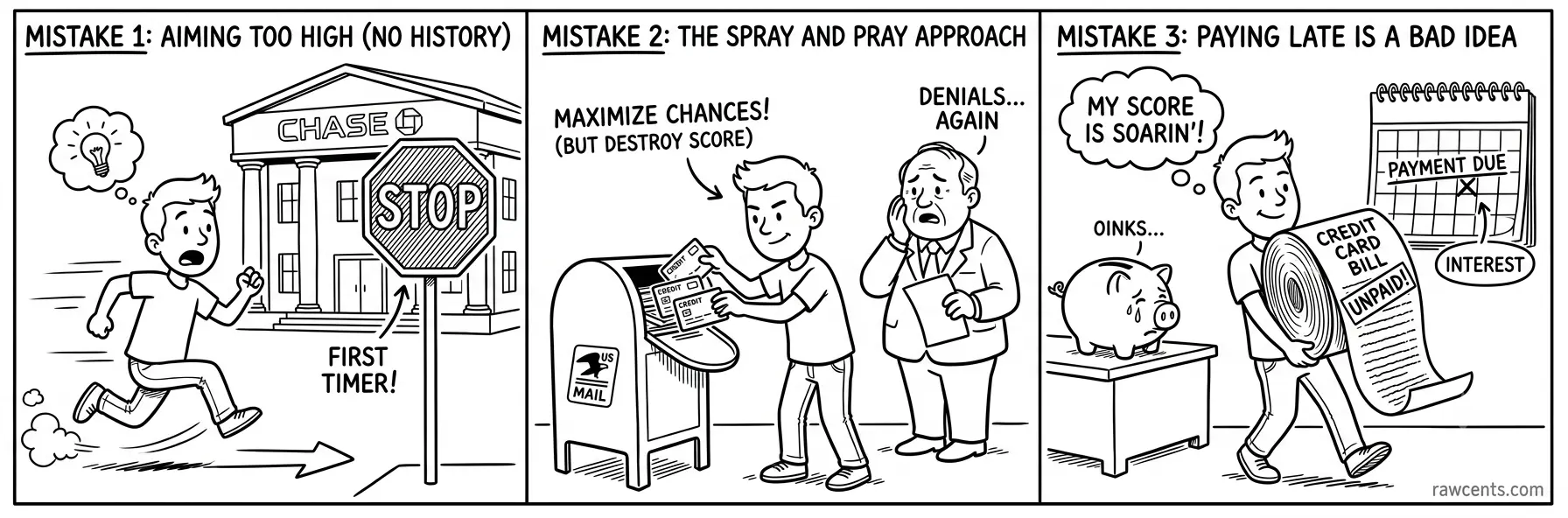
Mistake #1: Applying to Chase first. Chase’s preference for established revolving history means a thin file or an installment-only file is a common denial, and that denial still counts as a hard inquiry against a file that had little room to spare.
Mistake #2: Applying for multiple cards in the same week. Several inquiries landing close together read as new-credit risk to the scoring models, regardless of how well each individual account is later managed. Spacing applications out, and using prequalification tools first, avoids this entirely.
Mistake #3: Carrying a balance to “build credit faster.” It doesn’t. Paying in full every month still reports as an on-time payment, the factor the score actually rewards, while carrying a balance only adds interest with no additional credit-building benefit.
How to Use the Cards Once Approved
Keeping revolving utilization under 10% of the limit is a reasonable target, and it’s a stricter standard than the score technically requires. 30% utilization isn’t catastrophic, it’s simply less optimal than single digits. Most issuers report the statement balance to the bureaus, not whatever the balance happens to be on the due date, so a $500 limit with a $400 statement balance reports as 80% utilization even if it’s paid off before the bill is due.
One practical way to keep that number low without micromanaging two cards: assign one or two recurring bills to each card, like a streaming subscription or a phone bill, and set both to autopay in full. If either of you would rather not hand a real card number to every subscription service, some of these issuers also support virtual card numbers, which make it easy to cap or shut off a specific merchant without touching the underlying account.
Once both spouses have a few months of reporting history, a technique known as AZEO — All Zero Except One — becomes useful ahead of a bigger loan application, like a mortgage. Letting every card except one report a $0 statement balance, with that one card reporting a small balance around 1–2% of its limit, tends to score slightly better under both FICO and VantageScore than $0 across every account, which can occasionally trigger a minor non-use penalty. It’s worth timing in the months before a major loan application, not something to manage every single billing cycle.
What We Would Do
For this household, each spouse checks prequalification individually the same week. The 680-score spouse applies for the Citi Double Cash, listing household income if their individual income is lower. The no-history spouse skips unsecured Capital One and opens the Discover it® Secured with a $200 deposit, also listing full household income under the CARD Act provision.
Both cards get assigned one or two recurring bills, and both get paid in full automatically. On roughly $150 in monthly recurring charges per card, utilization stays in the single digits without either spouse tracking it by hand. At that pace, both are typically positioned for a graduation review, a limit increase, or a second card within eight to ten months, with two independent files instead of one shared account that only ever builds one person’s history.
Once both cards are actually open, it’s also worth a quick look at how to freeze your credit at all three bureaus and what to do if someone uses a card without permission — not because anything’s wrong, but because a newly opened file is exactly the kind of thin, low-activity account that’s easiest for someone else to exploit if it’s ever compromised.
FAQ
Can I get a credit card with absolutely no credit history? Yes. Discover and most secured card programs are built to approve applicants with no prior file, based on income, identity, and deposit amount rather than an existing score.
Can my spouse and I open a joint credit card together? Almost never with a major issuer. Chase, Citi, Capital One, Discover, and Amex have all phased out standard joint credit accounts; Apple Card’s Co-Owner structure is one of the few remaining exceptions.
Does a no-history spouse need to report their own income on a credit application? No. Under 12 CFR § 1026.51, applicants 21 or older can list household income, including a spouse’s, as long as they have reasonable access to it.
Why does Capital One cap some starter card limits so low? Its automated underwriting sorts new accounts into risk tiers at approval. A no-history applicant placed in a lower tier can see limit increases stall for years, which is why a secured card with a behavior-based graduation review is usually the safer starting point.
Does paying in full every month build credit faster than carrying a small balance? Yes. Paying in full still reports as an on-time payment, which is what the score rewards, while a carried balance adds interest without any credit-building benefit.
For more on income-reporting rules and credit card protections, the Consumer Financial Protection Bureau’s credit card tools are a reliable source, and each issuer’s own site (discover.com, capitalone.com, citi.com, chase.com) carries the most current rates and offers.
Match each application to the file that spouse actually has: secured or a beginner unsecured card for no history, a flat-rate cashback card for an existing score, applied for separately, not jointly. Revisit the lineup in six to twelve months, once real payment history exists on both files.
Disclaimer: The information on RawCents is for educational purposes only and does not constitute financial or investment advice. Always consult a qualified financial professional before making decisions about your money. Card terms, insurance rates, and government program rules are subject to change; verify current details with the issuer or relevant agency before acting.